Legal AI Agents: How Agentic AI Automates Legal Workflows
A legal AI agent is a form of legal AI software that plans, executes, and checks multi-step legal work on its own — not a chatbot that only answers a single prompt. Federal courts and state bars are actively writing the rules for this: more than a dozen states plus D.C. have issued formal ethics guidance on lawyers’ use of AI, and no state bar has issued an outright ban. More than 20,000 law firms, including roughly 80% of the Am Law 100, have adopted them in some form, according to the Thomson Reuters Institute. Legal professionals expect AI to free up around 240 hours per lawyer per year — worth close to $19,000 in billable time, per the Thomson Reuters Future of Professionals report.
This is a fast-moving, YMYL-adjacent topic: nothing below is legal advice, and every output from an agentic system still needs attorney review before it reaches a client or a court.
What Is a Legal AI Agent?
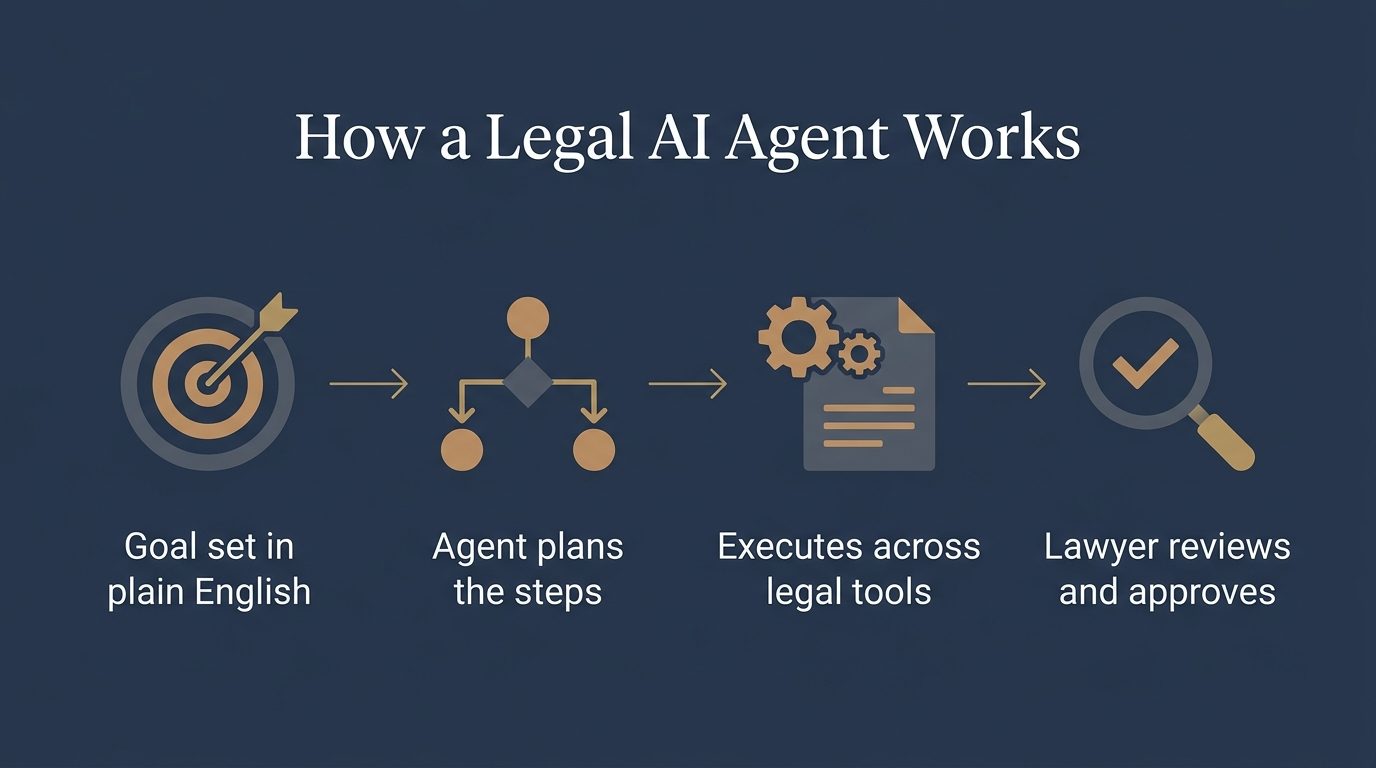
A legal AI agent is software built on a large language model that can consume information, apply reasoning, plan a sequence of steps, and carry a task through to completion — rather than simply generating a response and stopping. Thomson Reuters describes the core behavior as an agent that plans multi-step work, applies logic to build an argument or a document, and finishes the job, escalating to a human when it hits a decision it isn’t authorized to make. Under the hood, these systems combine an LLM (GPT-4/Claude-class reasoning) with memory, a reasoning framework, and the ability to call outside tools — a document management system, a research database, a calendar — in sequence.
From Chatbots to Agents: The Spectrum of Legal AI
Legal AI tools sit on a spectrum, and most vendors occupy more than one point on it:
- Chatbots — tools like ChatGPT or Copilot that take a prompt and return an answer, with no access to a firm’s own documents or systems.
- AI assistants — narrower tools that help with one task (summarizing a deposition, drafting a clause) but still wait for a human to direct each step.
- AI applications — purpose-built software that automates a defined workflow, such as contract redlining, within fixed rules.
- Agentic AI — software with access to tools and data that works autonomously across a multi-step task, deciding what to do next without a person prompting each move.
The distinction that matters for a law firm is access and autonomy: an agent that can open a document, query a database, and route a task to the right person is doing something categorically different from a chat window.
How an Agentic Workflow Runs: Plan, Execute, Verify
A single instruction like “conduct legal research on this issue” breaks down into a chain of subtasks that an agentic system runs largely on its own: understanding the underlying dispute, identifying the governing jurisdiction, building a timeline, pulling relevant precedent, and verifying that every citation is real and correctly stated. After each stage, the agent checks its own output before moving to the next one, and multi-stage quality control of this kind can catch inconsistencies a single human reviewer working under time pressure might miss. When the agent reaches a judgment call outside its scope — a novel legal theory, a client-specific risk tradeoff — it escalates to the supervising lawyer instead of guessing.
Agentic AI vs Generative AI: What’s the Difference for Lawyers?
Generative AI creates: it drafts a document, answers a question, or summarizes a transcript when a person asks it to. Agentic AI plans, decides, and acts across a sequence of steps, checking and explaining its own work along the way rather than producing a single output and stopping. A panelist at the InsidePractice Legal AI conference in New York put the distinction bluntly, in comments later cited by the Thomson Reuters Institute:
LLMs can write an essay, but agentic AI can research an essay.
Panelist, InsidePractice Legal AI Conference, via Thomson Reuters Institute
That difference also separates agentic AI from ordinary workflow automation tools like Zapier: a rules-based automation runs the same fixed sequence every time, while an agent makes decisions along the way and adapts when a document or a fact pattern doesn’t match what it expected. For a deeper side-by-side of what generative tools can and can’t do compared with purpose-built systems, see legal AI vs. ChatGPT.
| Dimension | Generative AI | Agentic AI |
|---|---|---|
| What it does | Creates content on request | Plans, decides, and executes multi-step tasks |
| Autonomy | Waits for a prompt at every step | Runs a sequence with minimal prompting |
| Typical example | Drafting a single clause | Reviewing a full contract against a playbook and flagging risk |
| Self-checking | None built in | Verifies its own output before proceeding |
| Main risk | Inaccurate single output | Compounding errors across an unsupervised chain of steps |
7 Legal Workflows AI Agents Automate
Agentic tools have moved fastest into workflows that are repetitive, document-heavy, and structured enough for a model to learn the pattern — while still leaving the final judgment call to a lawyer. Several vendors now market themselves directly as legal AI platform providers built specifically for these seven areas.
Contract Review and Drafting
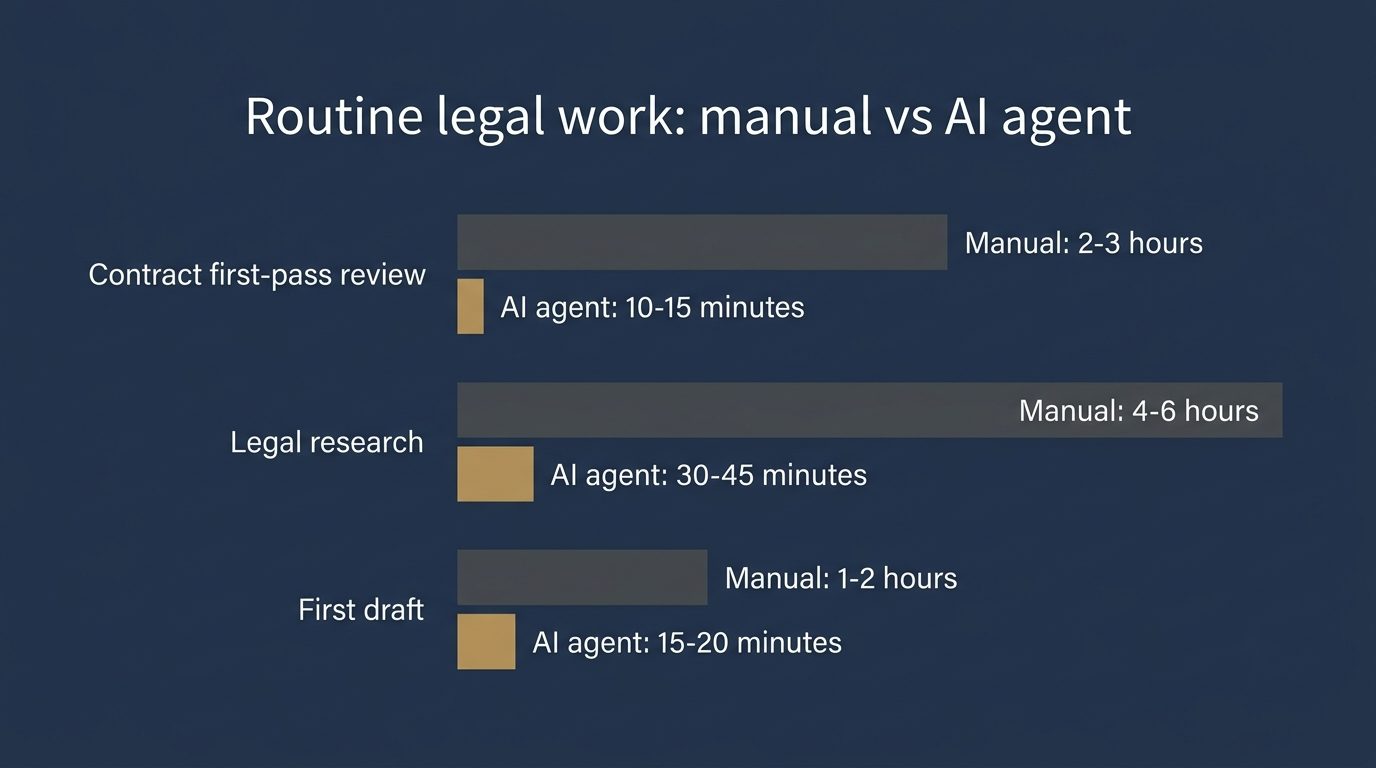
A lawyer reviewing a contract manually covers roughly 10-15 pages an hour, so a 280-page agreement can take close to three working days. An agentic contract tool finds key clauses, checks them against a firm’s playbook, flags deviations and risk, and proposes redlines, adapting its language to the governing jurisdiction and the client’s risk profile. First-pass review that took two to three hours can drop to 10-15 minutes, cutting total review time by as much as 90% on standard agreements.
Legal Research
Research that used to take four to six hours can compress to 30-45 minutes. The agent interprets the question, queries the relevant databases, filters and synthesizes the case law, and returns a summary with citations — running citation verification as a separate, dedicated step to catch the kind of hallucinated case that has already gotten lawyers sanctioned for filing AI-generated briefs.
Document Drafting
A first draft that used to take one to two hours now takes 15-20 minutes. Version management and adaptive drafting let an agent assemble complex agreements in minutes rather than hours by working from a plan instead of a single template. Incorporating a Delaware C-Corp, for example, becomes a multi-step plan: pull the right templates, check jurisdiction-specific requirements, and produce a ready-to-file draft rather than a blank starting point.
eDiscovery and Litigation Support
Intelligent filtering during eDiscovery cuts review time and cost by 60-80% on large document sets. Agentic tools now automate legal holds end to end — identifying custodians from HR and IT systems, sending hold notices, tracking acknowledgments, and running first-pass privilege and relevance tagging before a human reviewer ever opens the file. Deposition prep that used to take six to eight hours drops to two to three, and the more accurate agentic contract-analysis tools now report around 92% accuracy, ahead of most general-purpose LLM tools on the same task.
Client Intake and Communication
Clio describes a common scenario: while a lawyer is in court, an agent answers an incoming call from a prospective client, collects contact details, runs a conflict check, creates a CRM lead, drafts an engagement letter, and schedules the intake meeting — then opens the matter once the engagement is signed. Routine client communication of this kind eats up five to ten hours a week for a typical lawyer, time an agent can reclaim without the client ever waiting on a callback.
Compliance Monitoring
An agent can monitor regulatory changes continuously — tracking updates to GDPR, CCPA, or HIPAA — and cross-reference them against a firm’s or a client’s existing contracts and policies, flagging discrepancies as they appear rather than at the next scheduled audit. That matters concretely in areas like HIPAA compliance in vendor agreements or FDA and EMA compliance obligations buried in clinical trial contracts.
Billing and Practice Operations
Weekly billing tasks that took one to two hours can shrink to 15-20 minutes when an agent prepares time entries and invoices from the underlying work log. This kind of “work about the work” — administrative friction, status monitoring, follow-up emails — is the single biggest automation target for in-house legal teams, according to the Thomson Reuters Institute’s surveys of corporate legal departments.

Real-World Deployments: Who Already Uses Legal AI Agents
Adoption is concentrated among firms with mature technology functions, and most deployments are still in an active testing phase rather than fully autonomous production use.
- Thomson Reuters CoCounsel Legal shipped a Deep Research agent in August 2025 and is piloting bulk review of up to 10,000 documents in beta.
- LexisNexis rebranded Lexis+ AI to Lexis+ with Protégé in February 2026, adding 300-plus pre-built workflows and multi-model support across Anthropic, Google, and OpenAI models.
- Harvey AI prices its agentic offering at roughly $1,000-1,200 per lawyer per month, with a minimum of 20 seats.
- Wilson Sonsini built an agentic contracting tool on Dioptra, running on its internal Neuron platform under a fixed-fee arrangement.
- Taylor Wessing has deployed Legora, and Simmons & Simmons uses an NDA-review agent called Flank.
- Troutman Pepper Locke built Athena, one of Big Law’s earliest firmwide GenAI assistants, now used by roughly 62% of the firm and recently integrated with Thomson Reuters’ Deep Research for agentic legal research.
- KPMG Law US has paired with Google Cloud to build multi-agent platforms for its legal practice.
For a fuller side-by-side of what these platforms cost and where they differ, see best legal AI tools compared.
| Tool | Vendor | Agentic capability | Price signal |
|---|---|---|---|
| CoCounsel Legal | Thomson Reuters | Deep Research, bulk document review (beta) | Task-based pricing |
| Lexis+ with Protégé | LexisNexis | 300+ pre-built workflows, multi-model | Enterprise quote |
| Harvey AI | Harvey | Agentic contract and research workflows | ~$1,000-1,200/lawyer/mo, 20-seat minimum |
| Legora | Legora | Deal and NDA-review agents | From ~$3,000/year, 10-seat minimum |
| Clio Manage AI | Clio | Intake, conflict checks, engagement automation | $49-149/user/mo |
What the Numbers Say: Adoption and ROI
Gartner named agentic AI a top strategic technology trend and projects that 40% of enterprise applications will include task-specific AI agents by 2026, up from under 5% today; by 2028, it expects at least 15% of day-to-day work decisions to be made autonomously, versus effectively none in 2024. Gartner is candid about the other side of that curve too, forecasting that over 40% of agentic AI projects will be canceled by 2027, largely due to escalating costs, unclear business value, and inadequate risk controls — a signal worth weighing alongside the adoption numbers rather than instead of them.
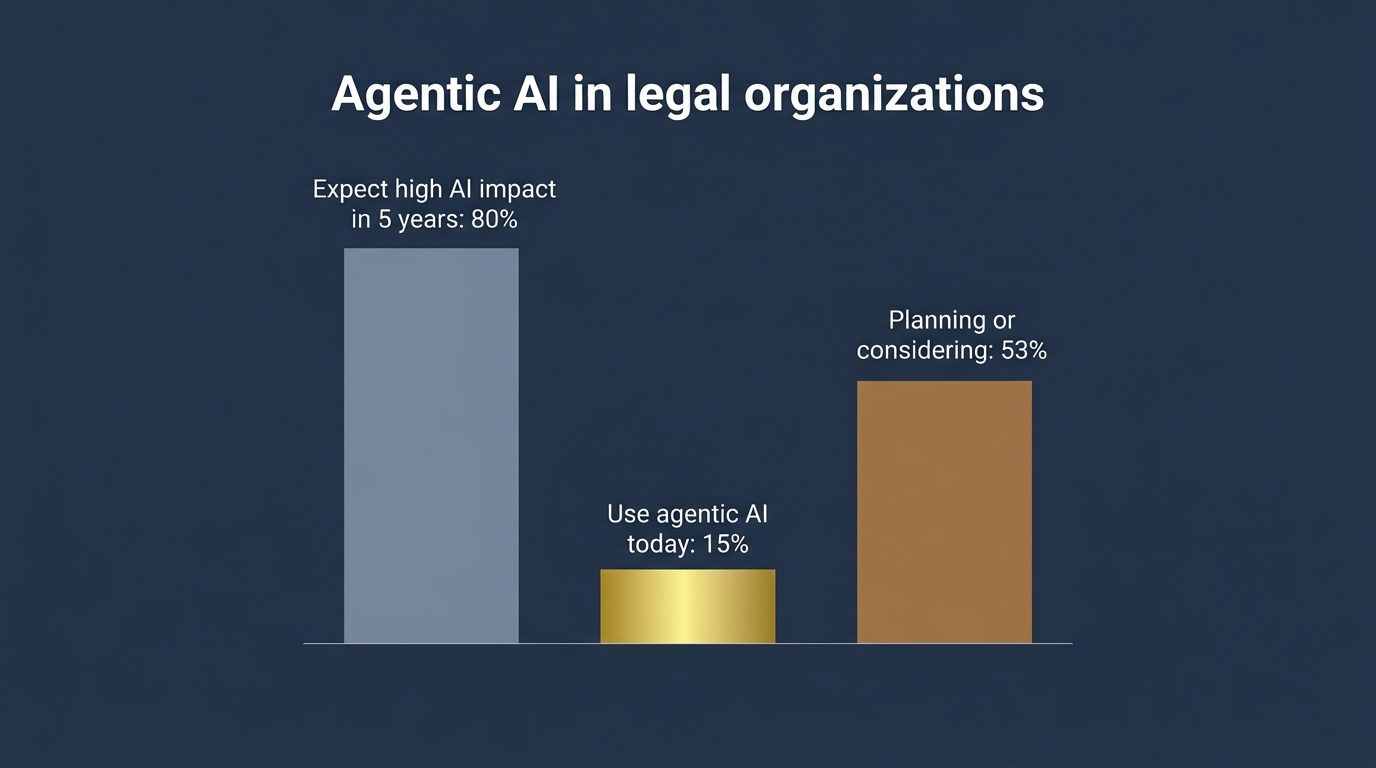
McKinsey estimates that up to 30% of hours worked across the US economy could be automated using current generative AI capabilities. Inside the legal industry specifically, the Thomson Reuters Institute has found that 80% of professionals expect AI to have a high or transformational impact on their work within five years, yet only around 15% of organizations currently use agentic AI, even as another 53% say they are planning or considering it. Professionals who have made the shift expect to reclaim the roughly 240 hours per lawyer per year — about $19,000 in billable time — cited earlier.
Risks, Ethics, and ABA Formal Opinion 512
The American Bar Association’s Formal Opinion 512, issued in July 2024, sets the baseline for lawyers using generative and agentic AI tools: competence in understanding the tool’s capabilities and limits, protecting client confidentiality, informing clients where appropriate, maintaining candor toward tribunals, supervising the tool’s output, and charging only reasonable fees for AI-assisted work. None of that changes because the AI is agentic rather than generative — if anything, the opinion’s supervision requirement is harder to satisfy when a system is executing several steps without a prompt at each one.
The supervising lawyer remains personally liable for harm caused by an agentic AI tool’s output, the same way they would be liable for a paralegal’s uncorrected mistake. Signal president Meredith Whittaker has warned more broadly that agentic AI erodes what she calls the “blood-brain barrier” between an application and the operating system it runs on, since an agent with broad tool access can take actions well beyond what any single app was designed to allow — a risk that maps directly onto a law firm giving an agent write access to a document management system or a client’s financial records.
The practical risks fall into a short list: autonomy without legal judgment, broad system access (agents that call external tools carry more risk than those confined to a closed, vetted system), and the difficulty of tracing why an autonomous agent made a particular decision after the fact. A minimum security checklist before adopting any agentic tool includes:
- Zero Data Retention commitments from the vendor
- SOC 2 Type II certification
- GDPR/CCPA-compliant data residency
- Privilege-safe architecture that segregates client matters
- Full audit logs of every agent action
The average cost of a data breach now runs around $4.44 million, and bar associations outside the ABA have so far issued only minimal agentic-specific guidance — this is regulatory territory that is still being written.
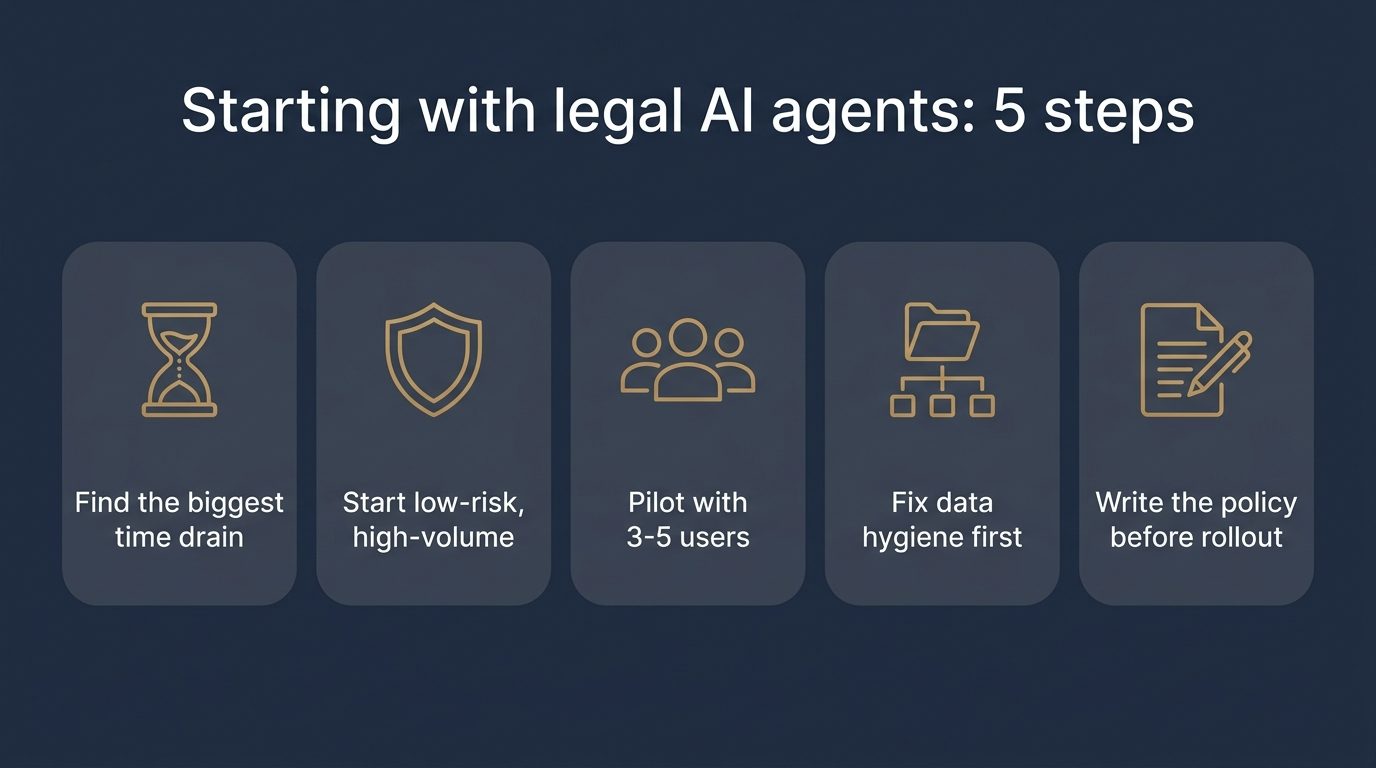
How to Start with Legal AI Agents: A 5-Step Roadmap
- Find the biggest time drain. Identify the single task eating the most non-billable or low-value hours before picking a tool.
- Start low-risk, high-volume. Deposition summaries, first-pass contract analysis, and NDA review are good starting points because errors are cheap to catch.
- Pilot with 3-5 users. Run higher-risk agents in a detection-only mode at first, where the agent flags but doesn’t act.
- Fix data hygiene first. Standardize document naming, matter structure, and templates before automating around them — you can’t automate a process you haven’t first made consistent.
- Write the policy before the rollout. Set an AI-use policy and escalation path in advance, and keep monitoring state bar guidance as it evolves.
The safest working rule: treat every agentic AI output the way you would a first-year associate’s work — often useful, never final without review, and this article itself is not a substitute for that review or for independent legal advice on your firm’s specific obligations.