

Legal AI: What It Is, What It Can Do, and How to Use It Safely
Legal AI is artificial intelligence applied specifically to legal work — legal research, document review, drafting, contract analysis, and compliance. Unlike a general chatbot, legal AI is built or grounded to work with case law, statutes, and legal documents, which is why it shows up everywhere from law firm workflows to a self-represented person trying to understand a lease. According to Wikipedia’s overview of the research field, artificial intelligence and law has been an active area of computer science and legal scholarship for decades, and generative AI has now pushed it into everyday use.
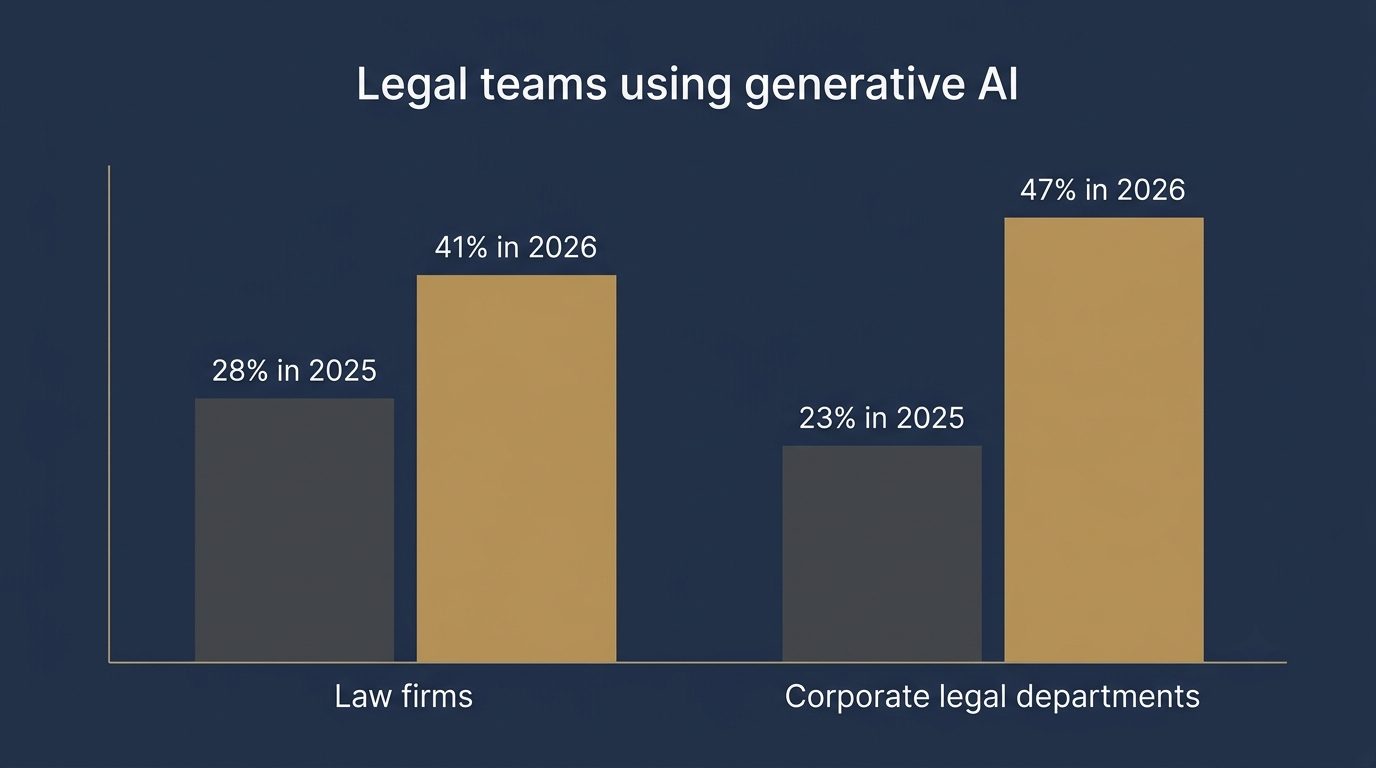
The scale of adoption is no longer marginal. About 31% of legal professionals personally used generative AI at work in 2025, up from 27% the year before, according to AffiniPay’s 2025 Legal Industry Report, a survey of more than 2,800 legal professionals. By 2026, 41% of law firms and 47% of corporate legal departments say their legal teams use generative AI — up sharply from 28% and 23% just a year earlier — per Thomson Reuters’ 2026 AI in Professional Services Report.
What Is Legal AI?
Legal AI is a category, not a single product — it spans everything from enterprise research platforms to free AI legal assistants aimed at consumers.
Definition and how it works
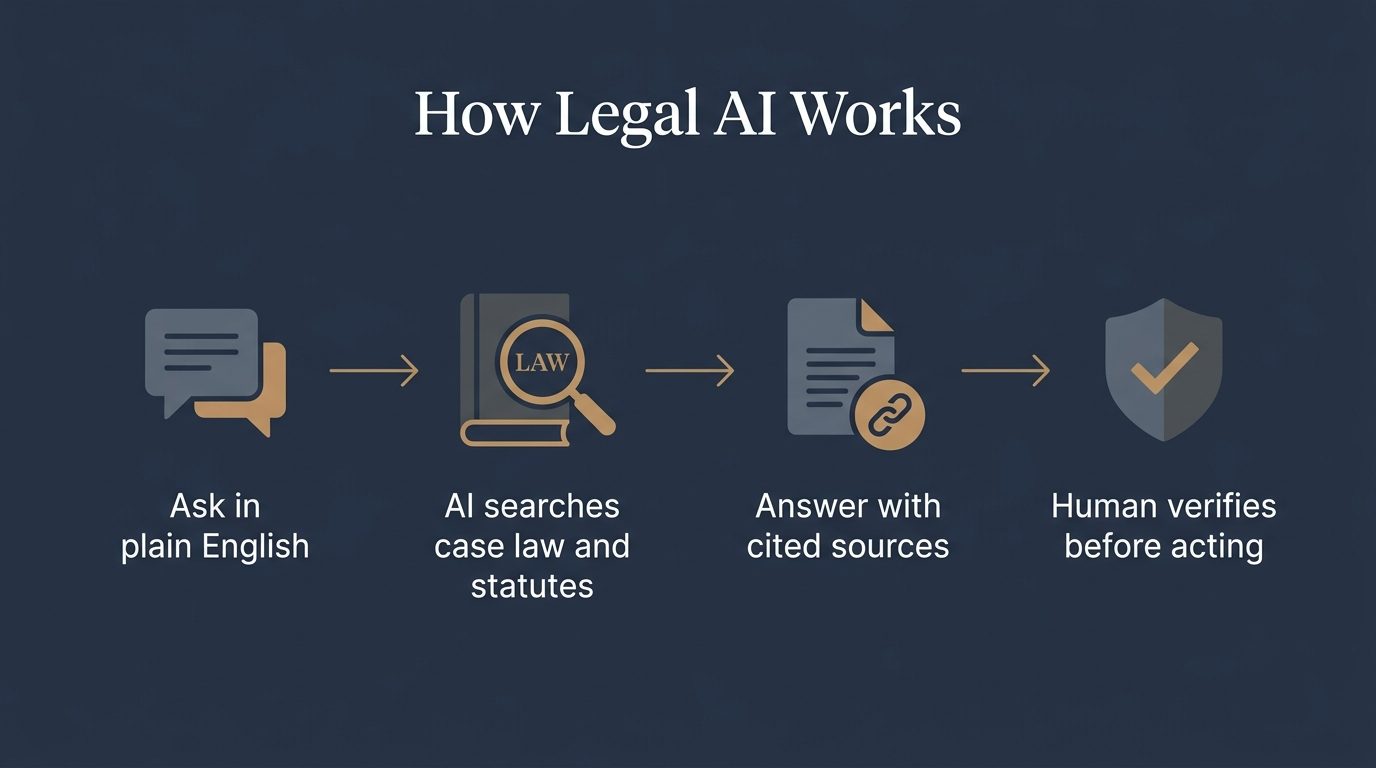
Legal AI is artificial intelligence applied specifically to legal work: reviewing contracts, drafting documents, researching case law, managing matters, and flagging compliance risk. Under the hood, most modern legal AI tools combine large language models (LLMs), machine learning, and natural language processing (NLP), often paired with retrieval-augmented generation so answers are tied to a specific set of legal documents rather than the model’s general training data. This overlaps with the broader academic field of artificial intelligence and law, which studies how computational methods can model legal reasoning, predict outcomes, and support legal research.
Legal AI vs. ChatGPT and general-purpose AI
A common question is whether there’s a “ChatGPT for legal.” The short answer is yes, but the distinction matters. General-purpose AI like ChatGPT is trained on a huge, unfiltered mix of internet text, so it can summarize a legal concept but has no reliable connection to actual case law or statutes. Legal AI platforms, by contrast, are grounded in dedicated legal databases — some vendors advertise access to more than 9 million court decisions from over 2,000 federal and state courts, describing the experience as ChatGPT with direct access to legal databases like LexisNexis or Westlaw.
That grounding also matters for confidentiality. Courts have found that using a consumer AI chatbot on an active legal matter can jeopardize attorney-client privilege, because information typed into a public tool isn’t protected the way communications with a lawyer are. Specialized legal AI platforms typically address this by keeping data isolated and by providing source references for every answer, so a user — lawyer or not — can verify a claim against the underlying case or statute instead of taking the AI’s word for it.
What Legal AI Can Do: Core Use Cases
Legal AI use cases fall into a few recurring buckets, and the time savings are measurable rather than anecdotal.
| Use case | What the AI does | Typical time impact |
|---|---|---|
| Legal research | Finds case law, statutes, and citations from a natural-language question | Minutes instead of hours of manual search |
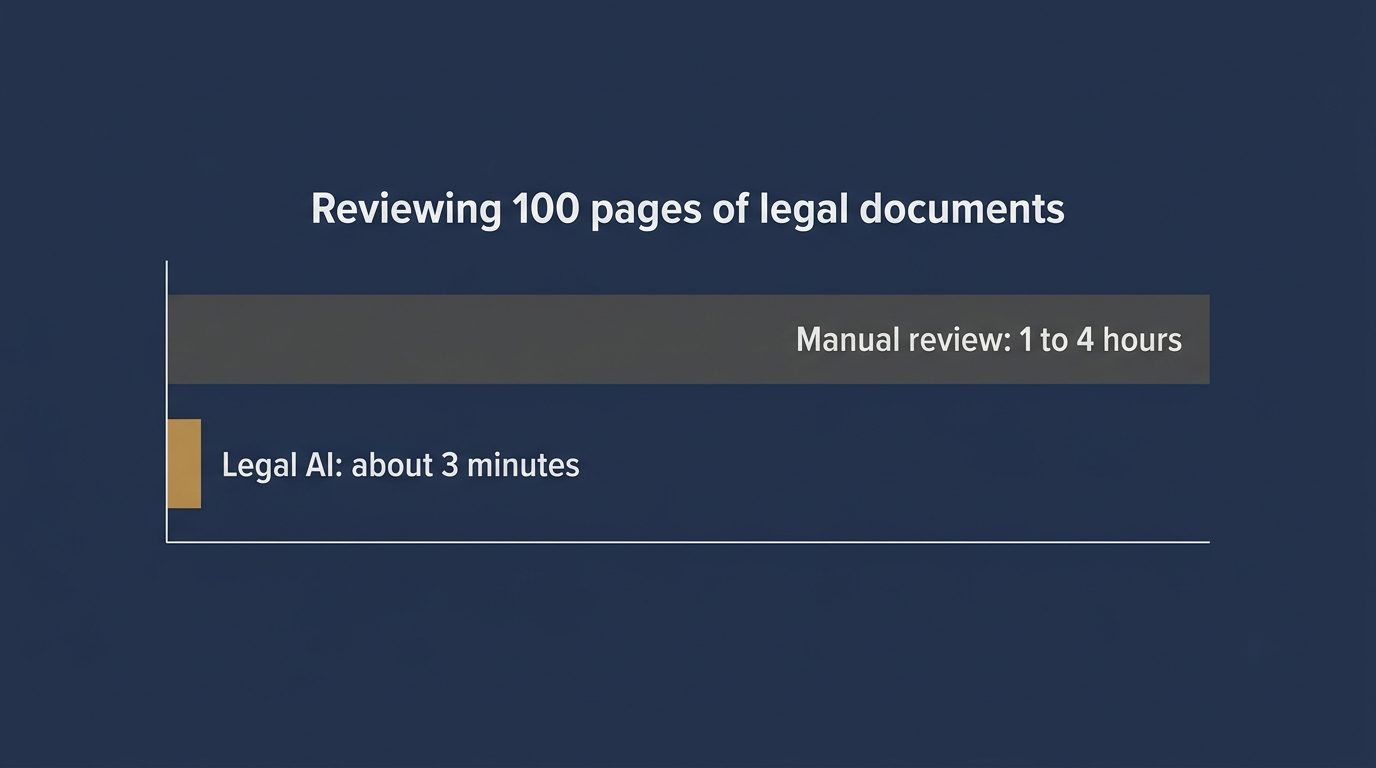
| Document review | Reads and answers questions about long documents | 100 pages summarized in about 3 minutes vs. 1–4 hours manually |
| Contract analysis | Extracts obligations, dates, and clauses | Roughly 98%+ extraction accuracy vs. 10–20% manual error rates |
| Drafting | Produces first drafts of contracts, letters, and briefs | Demand letters drafted up to 90% faster |
| Intake and analytics | Handles routine client questions and predicts case patterns | 24/7 availability, no added staff time |
Legal research and document review
AI-driven legal research lets a user ask a plain-language question and get back relevant case law, statutes, and verified citations, rather than manually searching Boolean-style databases. Document review is one of the most mature use cases: one enterprise platform reports reading and answering complex questions about 100 pages of documents in about 3 minutes, a task that typically takes a human reviewer one to four hours. In litigation, this extends to e-discovery — technology-assisted review, privilege review, and redaction of personally identifiable information across large document sets.
Drafting, contracts, and everyday legal documents
Lawyers reportedly spend up to 56% of their time on document drafting, and finding a usable starting point alone can eat up 15 minutes or more per document. Legal AI tools built for contract work claim extraction accuracy of 98% or higher when pulling obligations and key terms from agreements, compared with a 10–20% error rate in manual extraction — and manually reviewing something like 2,000 contracts can take more than 80 hours of attorney or paralegal time. On the drafting side, some platforms report generating demand letters roughly 90% faster than a from-scratch draft. For non-lawyers, the same technology underlies consumer-facing drafting tools, including:
- Demand letters and complaint letters
- Cease-and-desist notices
- Basic contract and agreement templates
- Wills, with state-compliant signing requirements
Intake, case management, and analytics
Handle client intake around the clock. Some legal AI platforms field calls and messages in dozens of languages so a firm doesn’t lose a potential client simply because it’s outside business hours.
Predict likely case outcomes from historical data. By analyzing patterns across thousands of prior filings and rulings, legal AI can flag how a judge or jurisdiction has historically ruled on similar matters, feeding into legal analytics tools used for case and judge research.
Compile medical chronologies for injury cases. Personal injury practices use AI to turn stacks of medical records into a structured timeline, a task that used to be almost entirely manual.
Move toward agentic AI. The next stage beyond single-answer chat is agentic AI — systems that carry out multi-step workflows autonomously, such as researching a question, drafting a memo, and flagging it for review without a human prompting each step. Multiple vendors have named this as a leading trend heading into 2026.

Legal AI for Non-Lawyers: Free Help With Everyday Questions
Not everyone who needs legal AI help is a lawyer — a large share of usage comes from people trying to understand their own situation. This is where a free legal AI assistant becomes genuinely useful, especially for people who can’t afford an hourly consultation just to get a plain-language answer.
What an AI legal assistant can answer
Yes, free legal AI exists, and it typically covers common, everyday situations. A free AI legal assistant can explain unfamiliar terms, walk through a general process, and help someone prepare questions before they ever speak with a lawyer. Typical topics include:
- Rental disputes and eviction notices
- Workplace and employment questions
- Consumer debt and collections
- Traffic tickets and minor citations
- Family law basics (divorce, custody procedures)
- Simple wills and estate planning documents
This matters because of what’s often called the justice gap: low-income Americans receive no or inadequate legal help for the large majority of the civil legal problems that affect them substantially, according to the Legal Services Corporation’s Justice Gap Report. LSC and resources listed on USA.gov exist specifically to help close that gap, and AI tools are increasingly a low-cost first step alongside them.
Where the line is: information, not legal advice
This is worth stating plainly, because it’s the single most important limitation of legal AI: an AI assistant provides legal information, not legal advice, and it does not replace a licensed attorney. As one legal AI vendor puts it bluntly, “an AI lawyer isn’t a real thing” — no current tool is a substitute for representation by a licensed lawyer, and none can appear in court on someone’s behalf. A live lawyer becomes necessary for:
- Court appearances and formal proceedings
- High-stakes transactions where a mistake is costly
- Criminal matters
- Anything with a hard statute-of-limitations deadline
Legal information from AI is not legal advice. It cannot account for every fact of a specific situation the way a licensed attorney reviewing a full case file can, and using it as a substitute for professional counsel on a serious matter carries real risk.

Accuracy, Ethics, and Regulation
Accuracy and professional accountability are the two biggest guardrails around legal AI adoption, and both are actively evolving.
Hallucinations and verification
The single biggest risk in legal AI is hallucination — a generative model fabricating a case citation, quote, or holding that sounds plausible but doesn’t exist. Courts in multiple jurisdictions have sanctioned attorneys for filing briefs containing AI-invented citations, which is why the standard advice is unambiguous: every AI-generated legal claim must be checked against the primary source before it’s relied on or filed. Serious legal AI platforms address this by linking directly to the full text of the cases and statutes they cite, and some vendors run their output through benchmark testing — one uses hundreds of attorney-authored test questions, another applies a reasoning-chain and meta-verification step before returning an answer.
Professional rules and AI law
In the United States, the American Bar Association’s Formal Opinion 512, issued in July 2024, sets out how existing ethics rules apply to lawyers using generative AI. The opinion covers four core duties:
- Competence — understanding a GAI tool’s capabilities and limitations before relying on it
- Confidentiality — not entering client information into tools that lack adequate protections
- Oversight — independently verifying AI-generated output before using it
- Reasonable fees — not billing clients for time an AI tool saved as if it were still manual work
On the core duty of competence, the ABA wrote:
Lawyers need not become GAI experts. Rather, lawyers must have a reasonable understanding of the capabilities and limitations of the specific GAI technology that the lawyer might use.ABA Standing Committee on Ethics and Professional Responsibility, Formal Opinion 512 (July 29, 2024)
Outside the United States, the EU AI Act is the first comprehensive AI law of its kind, taking a risk-based approach that categorizes AI systems — including some legal and justice-related applications — by their potential for harm and imposes stricter obligations on higher-risk uses. In the U.S., there is no single federal AI law yet; instead, oversight comes through state bar ethics rules and a growing number of court standing orders that require parties to disclose when AI was used to help prepare a filing.
Data Security and Confidentiality
Security practices vary widely across legal AI vendors, so this is one area worth checking before trusting a platform with anything sensitive.
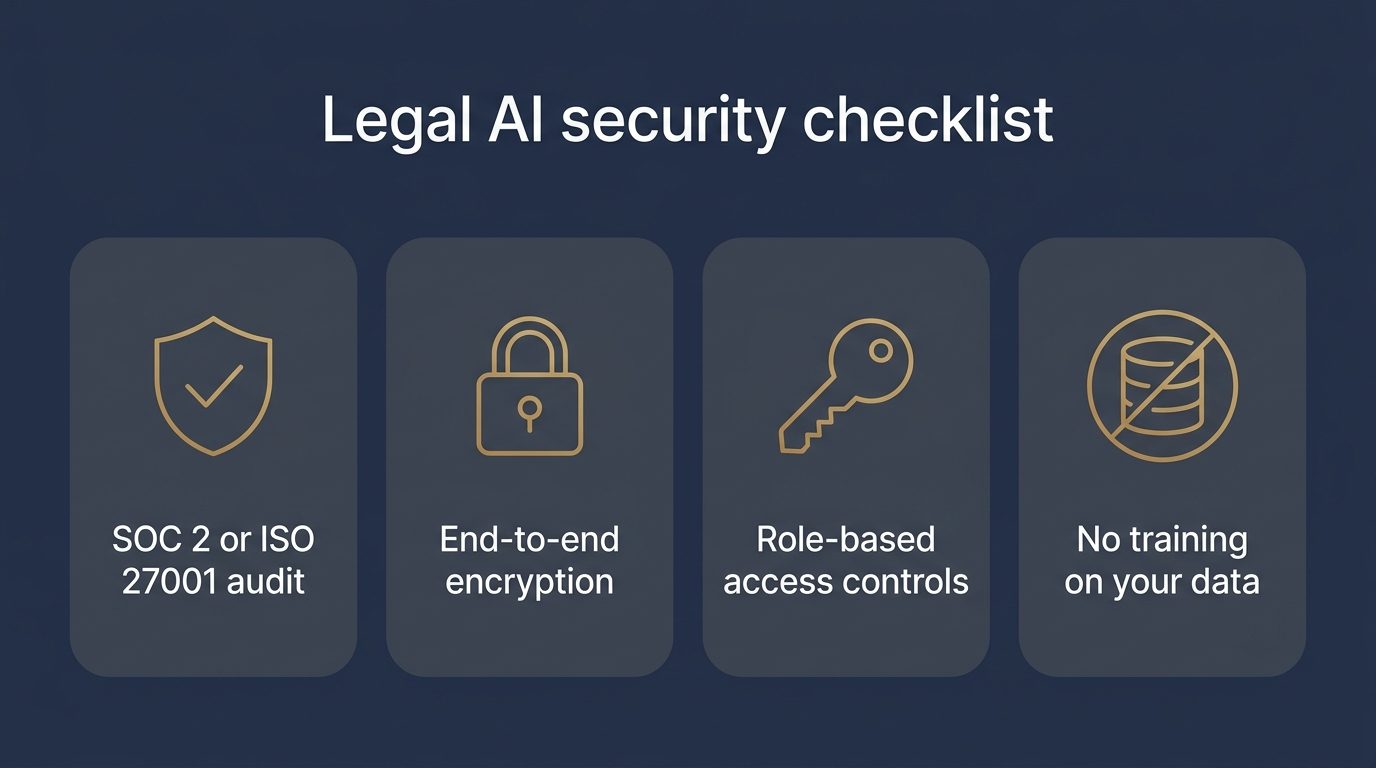
| What to check | Why it matters |
|---|---|
| SOC 2 Type II / ISO 27001 certification | Independent audit of how the vendor secures and handles data |
| ISO 42001 (AI governance) | Newer standard covering how a vendor manages AI systems responsibly, not just data security |
| Encryption in transit and at rest | Data stays protected both while moving between systems and while stored |
| Role-based access controls | Only people who need to see a matter’s data can access it |
| No-training data policy in writing | Confirms customer or client data isn’t used to train the vendor’s public models |
For lawyers, protecting client data through a vetted platform isn’t optional — confidentiality is an ethical obligation, not just good practice. For everyday consumers, the practical version of the same advice is simpler: avoid pasting another person’s private information into a general AI tool, and skim the privacy policy of any free legal AI assistant before using it for anything sensitive.
How to Start Using Legal AI
Adoption tends to go better when it starts small and deliberate rather than firm-wide on day one. In fact, roughly 65% of lawyers who use AI say it saves them up to five hours a week, and one enterprise platform reports more than 142,000 legal professionals across 60-plus countries using it, with one vendor’s commissioned research estimating a 344% three-year return on investment for a major legal research AI product.
A practical way to start, whether you’re a solo practitioner, an in-house team, or simply someone who wants free legal AI help for a personal question, looks like this:
- Pick one low-risk, high-volume task to start with — summarizing research or drafting a routine letter, not a live courtroom filing.
- Choose a law-specific tool over a general-purpose chatbot whenever the task touches real legal documents.
- Verify every citation and factual claim against the primary source before relying on it.
- If you’re at a firm, put a written AI-use policy in place and train staff on it before rolling the tool out more broadly.
- Track the actual effect — hours saved, turnaround time — instead of assuming it’s working.
The upside compounds with consistent use: firms report saving 20 or more hours a month once a tool is embedded into a regular workflow, not just used occasionally.
Frequently Asked Questions
- Is there a free legal AI?
Yes. Several platforms offer a fully free AI legal chat or a free tier for common questions, with paid plans starting around $5 a month for more advanced features. Free versions are well suited to general questions; complex or high-stakes matters still need a licensed attorney.
- Which legal AI is best?
It depends on the task. For enterprise legal research and drafting, established platforms serve large numbers of law firms and corporate legal departments. For everyday personal questions, a free legal AI assistant is usually enough. The best choice is the one with clear source citations, verification, and documented security practices.
- Is there a ChatGPT for legal?
Yes — a category of law-specific AI chat tools works similarly to ChatGPT but is grounded in legal databases of case law and statutes. The key difference from a general chatbot is that answers come with source references, which reduces (but does not eliminate) the risk of fabricated citations.
- Can legal AI give legal advice?
No. Legal AI provides legal information, not legal advice — only a licensed attorney can give legal advice. A relationship with a lawyer also carries attorney-client privilege protection that a conversation with an AI tool does not have.
- Will AI replace lawyers?
Not based on current evidence. AI is taking over routine work such as document review, first-draft writing, and research summaries, but legal judgment, strategy, and accountability remain with the lawyer. Adoption is rising fast, but the consensus among legal AI vendors and industry surveys is that it functions as a force multiplier, not a replacement.
- Is my data safe with legal AI?
It depends on the vendor. Look for SOC 2 or ISO 27001/42001 certification, clear encryption practices, and an explicit statement that customer data isn’t used to train public models. For active legal matters, use a vetted, security-certified platform rather than a general-purpose public chatbot.